The Text of Psalm 19
“To the leader. A Psalm of David.
1 The heavens are telling the glory of God;
and the firmament proclaims his handiwork.
2 Day to day pours forth speech,
and night to night declares knowledge.
3 There is no speech, nor are there words;
their voice is not heard;
4 yet their voice goes out through all the earth,
and their words to the end of the world.
In the heavens he has set a tent for the sun,
5 which comes out like a bridegroom from his wedding canopy,
and like a strong man runs its course with joy.
6 Its rising is from the end of the heavens,
and its circuit to the end of them;
and nothing is hid from its heat.
7 The law of the Lord is perfect,
reviving the soul;
the decrees of the Lord are sure,
making wise the simple;
8 the precepts of the Lord are right,
rejoicing the heart;
the commandment of the Lord is clear,
enlightening the eyes;
9 the fear of the Lord is pure,
enduring forever;
the ordinances of the Lord are true
and righteous altogether.
10 More to be desired are they than gold,
even much fine gold;
sweeter also than honey,
and drippings of the honeycomb.
11 Moreover by them is your servant warned;
in keeping them there is great reward.
12 But who can detect their errors?
Clear me from hidden faults.
13 Keep back your servant also from the insolent;
do not let them have dominion over me.
Then I shall be blameless,
and innocent of great transgression.
14 Let the words of my mouth and the meditation of my heart
be acceptable to you, O LORD, my rock and my redeemer.”
Background of the Psalm
- It is identified as a psalm of David. Roughly half of the psalms in the Book of Psalms are by David or attributed to David.
- This psalm has no further historical context.
- “To the leader” suggests that though this psalm probably was first David’s personal meditation, prayer and song to God, it later made it into the first collection of psalms, called “Book 1” (see headline before Psalm 1) and was given this practical instruction.
- “Book 1” contains Psalms 1 – 41, mostly personal psalms by David. It is assumed that David himself is the publisher or editor of “Book 1” and so it is usually dated at roughly 1000 BC.

First part of the Psalm Psalm 19:1-10
- David is meditating on the greatness, vastness and awesomeness of the sky, both at night (maybe contemplating the endless stars in a night sky, the expanse of the universe, Psa 19:1-4) and during the day, with the sun as the central feature (Psa 19:4b-6).
- David meditates on God’s creation, his handiwork. The physical creation was created by God, wanted by God, is sustained by God and is worthy of human contemplation, even awe.
- The night or day sky is ‘silent’ in one sense “there is not speech, nor are there words; their voice is not heard”, but yet it “pours forth speech … declares knowledge … their voice goes out through all the earth, and their words to the end of the world”. This paradox is expressed eloquently in verses 3 to 4.
- God’s creation speaks loudly about its Creator, creation reveals the Creator. Creation is “telling the glory of God”, it “proclaims his handiwork” (Psa 19:1).
- These words reach “the end of the world” (Psa 19:4), meaning that the witness of creation to its Creator is universal, it is something understood by everybody to one degree or another (Rom 1:20).
- David’s words surely imply that he cannot but draw conclusions: Behind creation he sees the “glory of God”, the greatness, vastness, awesomeness of the sky, so far above, so beautiful, so powerful.
- He describes the sun and the course it is running across the sky as a bridegroom, coming out of his wedding canopy, and like a strong man that “runs its course with joy” (Psa 19:4b-5).
- The metaphor “bridegroom” implies the sun being the ‘star of the show’, the ‘central figure’, strong, active, attractive, revealed and celebrated, a happy and appropriate picture of both joy and strength (Psa 19:6).
The second part of the Psalm – Psalm 19:7-11
- In a quite abrupt change David starts focusing on the Law, the decrees, the precepts, the commandments, the ordinances or (in some translations) the Word of God (Psa 19:7-11). These terms are really used interchangeably, in multiple parallel lines and thoughts.
- David’s meditation and description of the Law of God is remarkable: The Law is perfect, reviving the soul, sure, making wise the simple. It is right, rejoicing the heart. It is clear, enlightening the eyes. It is pure, enduring forever. It is true, altogether righteous, desirable (more than gold) and sweet (more than honey). It warns humans. In the keeping of the law is great reward.
- What ‘word of God’ is David reading? At best the books David has access to are Genesis to Samuel, the other books are yet to be written. David clearly refers to the Law of Moses.
- Would we call the Law of Moses perfect? Reviving? Desirable? Sweet? We surely have a different view of the Law. We look at the Law as the thing we are glad we are no longer under. That is about the best we can manage.
- How unbelievably high David’s view of the Law is! Maybe we are missing something? Maybe we are not understanding?
- As with creation, David thinks the Law as simply amazing and utterly excellent. Like creation was a revelation of God, so the Law is a revelation of God.
- What does the Law reveal about God?
- The Law basically is a revelation of the will of God, what he wants and doesn’t want. What is good and what isn’t good. What humans are meant to do and what they are not meant to do.
- More foundationally the Law is a revelation of the character of God. It is because God is just that he wants to see justice among humans. It is because God values life and the individual, that murder is forbidden. It is because God is committed to all humans that the weak have to be protected. It is because humans are in the image of God that unalienable rights are theirs.
- The Law contains the wisdom of God, the values of God, the right placing of priorities. The Law anchors human value, human rights and freedom.
- The Law is the basis of all Biblical Worldview. We would not know how to think about God, ourselves, our neighbors, nations and this physical world unless we had Genesis. We would not know how evil came to be and why it is is not all-powerful, nor the ‘final reality’. The Law explains the condition of man and the world – and predicts what God will do to rectify it.
- The Law is reviving, rejoicing and enduring. It does us good. In keeping it there is great reward.
The third part of the Psalm – Psalm 19:12-14
- The third part starts with David asking himself a question: “But who can detect their errors?” (Psa 19:12).
- It seems that in the light of this pure Law David’s thoughts invariably end up with his own unworthiness.
- “Clear me from hidden faults.” This assumes that David has long ago and continually since asked God’s forgiveness for any known sin. But now – in the light of the justice and perfection of the Law – he wonders how much he is not seeing and not repenting of.
- David is humbled, aware of his need, of his impurity. He asks for forgiveness for wrong he is not seeing that he is committing, and for protection from the insolent, those who don’t care about right and wrong.
- David is well aware of his role and responsibility in this – he must confess sin, he must want purity, ask for help. But he equally knows that none of this can be achieved by human effort or will, however heroic, it is the grace of God.
- He confesses God as his Rock and Redeemer, the one to steady him, the one to save him. He ends with a humble request, that – somehow – his word and thoughts may be pleasing to God.

The Progression is this Psalm
- At first glance the three parts of this psalm may not be overly connected, especially the first and second part. But really, they are very strongly connected:
- It seems that David starts with a meditation on creation that meets his eye, the vast star sky, the sun in all its glory. He is overwhelmed with the greatness and beauty of creation, and even more so with the Creator who is behind all this – powerful, vast, awesome.
- But this God is not only powerful and awesome – and far away, this God has given revelation of himself into this world in the form of the Law. God is not only the remote Creator way back when, he is the God who has a claim on our lives. And the claims he has – his Law – are pure and just – but they also reveal just how far away we humans are from what we were supposed to be.
- David loves the Law, he recognizes it as a reflection of the good, eternal and excellent character of God, entirely just, entirely right, entirely good, fully beneficial – if only we keep it.
- In front of the awesome God of creation whose character is also the basis for the just and true claims of the Law – David feels unworthy, and rightfully so.
- Every real revelation of God through Creation or through the Word of God will leave us humbled, aware of your smallness, aware of our need.
- So to this awesome and just God he turns – for who else is there to turn to? – humbly, requesting that some how he could be accepted.
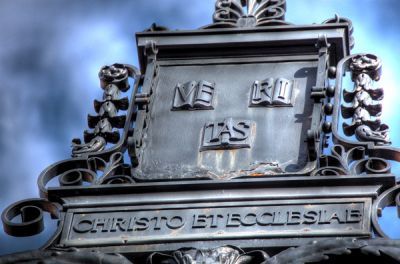
- The reformators thought of creation as the ‘first of God’s book’, the Bible being the second. This shows the reformators’ positive view of science and the physical world.
- This concept is depicted on the coat of arms of Harvard University. The third book shown is inverted, signifying the limits of human knowledge and reason, and therefore the need for God’s revelation, which needs to be accepted with humility. Together the three books constitute “Veritas”, truth.