Matthew 4:1
“Then Jesus was led up by the Spirit into the wilderness to be tempted by the devil.”
- Immediate context is important: in the verse just prior (Mth 3:17) Jesus has been affirmed by the Father to be “his beloved Son” with whom He is “well pleased”.
- Also the current verse: it is by the Spirit’s leading that Jesus is in the wilderness, is fasting and is being ‘set up for temptation’.
- The temptation happens by God’s will, by the Spirit’s leading, as fully loved, endorsed, affirmed and commissioned by God.
- To be tempted then is in no way sin, sinful, caused by sin, because of sin or anything. It’s not a discipline, a punishment, a judgment, nor a statement of God’s displeasure, doubt or mistrust towards us.
Matthew 4:2
“He fasted forty days and forty nights, and afterwards he was famished.”
- This extreme fast (as opposed to more normal regular fasts often practiced by Jews) is by the guidance of the Spirit.
- Medically speaking 40 days is a limit: a zero-calorie diet for a before healthy person is the limit, from day 41 or 42 of starvation irreversible damage to the body sets in and the risk of dying goes up strongly.
- This fast puts Jesus into a state of extreme physical and (likely) mental weakness.
Matthew 4:3
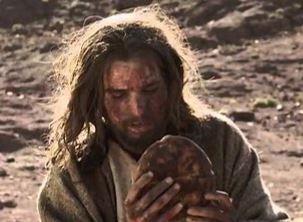
“The tempter came and said to him, “If you are the Son of God, command these stones to become loaves of bread.”
- Satan is merciless and shameless in attacking the victim at the point of greatest weakness.
- What exactly does he tempt Jesus with? And tempt Jesus to do?
- The attack is primarily on Jesus’ identity as the Son of God: “If you are the Son of God …”. Satan attempts for Jesus to be insecure or feel under pressure to prove his identity by producing a miracle, a supernatural event.
- Likely there is also an unstated complaint: ‘If you were God’s beloved Son, why would he let you suffer like this?’ > an attack on the goodness and wisdom of God in asking for this fast.
- The temptation is also for Jesus to use his power (the ability to turn stones into bread) for his own needs, selfishly so to speak, without the express instruction of the Holy Spirit, self-governed, self-appointed.
- The temptation is also for him to know better than God what one needs, to doubt God’s ways, wisdom, goodness, to ‘organize for oneself what God seems to be wrongly withholding’, which is exactly the sin of Adam and Eve.
Matthew 4:4
“But he answered, “It is written, ‘One does not live by bread alone, but by every word that comes from the mouth of God.’ ”
- Satan starts with a legitimate need: humans do need food, and Jesus is truly on the brink of starvation. Jesus is not denying that, neither is the Father.
- Jesus withstands the pressure: He will not doubt nor prove his identity as the Son of God. He will not doubt God’s goodness, wisdom or care. He refuses to take matters into his own hands.
- Jesus quotes from Deu 8:3, Moses speaking to Israel about God and the wilderness time (a direct parallel to Jesus now): “He humbled you by letting you hunger, then by feeding you with manna, with which neither you nor your ancestors were acquainted, in order to make you understand that one does not live by bread alone, but by every word that comes from the mouth of the Lord.”
- Here humility is associated with letting God determine what and how we eat (both in lack “letting you hunger” and by abundant, miraculous and tasty provision “feeding you with manna”), the letting our lives be governed by God, trusting that he will give what is needed, that even in lack he is present and has a good purpose.
- Here humility is also linked to humans needing the Word of God at least as much as food. That bread is needed is acknowledged (“not by bread alone”), but it is not the only need, not even the more important need and definitely not the overruling need. To know God’s word, his will, his ways, his character is more important than having needs met.
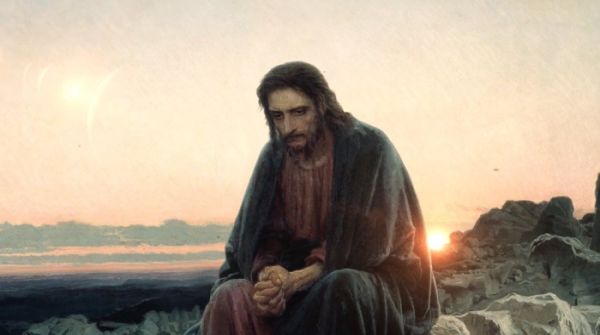
- There is an issue of priority here. Do I know better what I need or does God? Can I trust him with my needs, my health, my safety, my life? Is God both good and wise? Can I let go of ‘logic necessities’, ‘common sense’, ‘legitimate needs’, ‘rights’, ‘knowing better’, ‘self-accommodation’, ‘self-ordained action’, ‘the need to know why’?
- Jesus will not doubts God’s ways, he refuses to know better, he also steers clear of self-pity, sour sacrifice or hidden resentment against God. He will not doubt God’s goodness, leading or wisdom.
- He will remain satisfied with what God has given (versus what he has not given: food), which is the Word God.
- God has given that – this could refer to God’s goodness of character as revealed in the Bible, it could refer to what God just spoke “this is my beloved son with whom I am well pleased”, it could refer to the current leading by the Spirit to remain in this long fast, … or to all together.
Matthew 4:5-6
“Then the devil took him to the holy city and placed him on the pinnacle of the temple, 6 saying to him, “If you are the Son of God, throw yourself down; for it is written, ‘He will command his angels concerning you,’ and ‘On their hands they will bear you up, so that you will not dash your foot against a stone.’ ”
- Satan is not deterred. Just as the fact that you are doing good (“my beloved son with whom I am well pleased”) doesn’t mean you should be above temptation, the fact that you did well at one temptation doesn’t mean that you are now safe from or exempted from another.
- To assume that because you did well with one temptation, you shouldn’t face another one is simply setting you up to fail in the next one.
- Again Satan starts with an “if you are the Son of God”, one aspect of this second temptation is again to doubt, assert or try to prove your identity.
- This time Satan himself quotes Scripture, an excerpt from Psa 91:10-12 “No evil shall befall you, no scourge come near your tent. For he will command his angels concerning you to guard yo in all your ways. On their hands they will bear you up, so that you will not dash your foot against a stone.”
- This beautiful psalm describes the power of God to rescue his people from all kinds of circumstances, problems, catastrophes and attacks.
- Satan uses the Psalm to tempt Jesus to test God’s care or commitment to him.
- After all God has said he is pleased with Jesus, so Satan comes with the Psalm that says “those who love me, I will deliver” (Psa 91:14).
- Does God love Jesus? > yes. Is God well able to protect him miraculously? > yes. Is God committed to Jesus? > yes.
- What exactly is the temptation then? I think it is to precipitate a situation where God ‘has to act’, to create a ‘binary situation’, to force God’s hand, to test for God’s commitment to me or to his Word, which would be a very wilful use of the Word of God.
- Maybe since in the first temptation Jesus ‘won’ by placing value on the Word of God over obvious necessities, here Satan tries to twist this ‘valuing of the Word’ into something that is wilful.
- Or maybe the two temptation are quite alike, the temptation is to step outside of the guidance and will of God to do something perceived necessary (food) or mandatory (protection). It’s to assume I know what is needed now, it is to ‘get God to agree’ with my take on the situation or with my will.
- Or is it simply a temptation to spiritual pride to one who has just been declared “the beloved Son” and who has passed the earlier temptation with flying colors?.
- Or maybe there are other aspects? I am not sure I understand fully what all this temptation includes.
Matthew 4:7
“Jesus said to him, “Again it is written, ‘Do not put the Lord your God to the test.’ ”
- Jesus counters with Scripture (Deu 6:16): “Do not put the Lord your God to the test, as you tested him at Massah. You must diligently keep the commandments of the Lord …”.
- This is Moses at the end of his life reminding Israel of earlier events in their history as well as of God’s law.
- The story of Massah is found in Exo 17:1-7, when Israel, some time after the Red Sea Parting are camping before Sinai and are in need of water.
- They complain to Moses “Why did you bring us out of Egypt, to kill us and our children and livestock with thirst?”.
- Moses cries out to God, saying “They are almost ready to stone me”. God then has Moses strike a rock with his staff and provides water.
- Moses calls the place Massah (meaning ‘test’) and Meribah (meaning ‘quarrel’).
- Of course Israel’s need for water is immediate, obvious and legitimate. What then is the problem? It’s the attitude Israel displays.
- They credit Moses with the exodus from Egypt, not God.
- They talk as if they had no choice but following after Moses.
- Thirdly they charge Moses with evil motives, when he is as thirsty and as stuck as they are.
- Fourthly they express a faithless perspective: The God who parted the Red Sea just maybe able to do something about their legitimate need! There is no gratefulness for past deliverance, no acknowledgment for the daily provision of Manna, no faith expressed. They haven’t learned anything about God’s goodness, faithfulness or power in spite of massive supernatural deeds done in front of their eyes.
- It seems this self-centered demanding of God to do something now, or otherwise he is not good (present in both the first and second temptation) that is the testing of God here.
- Jesus will have nothing to do with it. Jesus doesn’t attempt to force the hand of God. He stays submitted to God’s ways.
Matthew 4:8-9
“Again, the devil took him to a very high mountain and showed him all the kingdoms of the world and their splendor; 9 and he said to him, “All these I will give you, if you will fall down and worship me.”
- I have often heard preached that since Jesus doesn’t challenge Satan on his claims that he has the power to give all the kingdoms of the world to him, that this shows they all indeed do belong to Satan. I think this deduction is likely wrong, Satan is the Father of lies, after all, so he may well be lying here.
- What Satan projects here will indeed be fulfilled, but in the right way: “The kingdom of the world has become the kingdom of the Lord and of his Messiah, and he will reign forever and ever” (Rev 11:15).
- What exactly is the temptation here? I think it is for Jesus to take a shortcut road to glory, one where no obedient life of service and no painful death on the cross will be required.
- In that sense all three temptations are similar, they are all temptations to think I can do “it” in a way other than God’s. It’s a stepping out of submission and obedience, either into getting myself what I need (1st temptation), into precipitating a situation that forces God’s hand (2nd temptation) or into doing things my way.
Matthew 4:10
“Jesus said to him, “Away with you, Satan! for it is written, ‘Worship the Lord your God, and serve only him.’ ”
- Upon hearing this proposal Jesus addresses Satan straight as Satan. It is thinkable that the first two temptations presented themselves as thoughts in Jesus’ mind (not so much as a visible snake or being speaking to Jesus). Maybe that’s why Jesus did not respond with an “away with you” the first two times.
- But if there was such a subtlety or disguise about the first two temptations, Satan drops that on his third and comes full out: “worship me”.
- For Jesus to ‘take things into his own hands’ would have been to step out of obedience to God and therefore to bow to Satan’s agenda.
- Satan sinned by pride, by self-exaltation, by self-centeredness … Jesus will not. He stays humble, submitted, trusting in God and entrusting his needs and ways to the Father.
- Jesus comes back with another quote from Scripture “Worship the Lord your God, and serve only him” (Deu 6:13). Worship only God. Jesus knows the Word and the character of God.

Matthew 4:11
“Then the devil left him, and suddenly angels came and waited on him.”
- Satan has to obey Jesus command, his authority.
- Within seconds of passing the third temptation all things change. Jesus has passed through the eye of the needle. The very needs he was sorely tempted for (food) are met a moment later.
- It is often so that the sorest temptations are just before things fulfill and God comes through.