Different women mentioned in the NT that are called Mary
The New Testament writers mention a minimum of 7 women called Mary, usually adding a description so as to distinguish them from each other:
- Mary, mother of Jesus, wife of Joseph, of the tribe of Judah
- Mary Magdalene
- Mary, the mother of James the younger and Joses
- Mary, the sister of Lazarus and Martha
- Mary, the wife of Cleopas
- Mary, the mother of John Mark
- Mary, a believer in the Roman church
It is possible that two different description are used for the same Mary (for example Mary, the mother of James the younger and Joses could possibly be the wife of Cleopas). But this is not likely as it seems the early church referred to each Mary mentioning an attribute to distinguish her from other Maries.
A complete listing of verses referring to each Mary
Mary, mother of Jesus
There are many references, given in consecutive order in the following study. But first the other six Marys:
Mary Magdalene
- Luk 8:2 Followers of Jesus: “as well as some women who had been cured of evil spirits and infirmities, Mary, called Magdalene, from whom seven demons had gone out.”
- Mrk 15:40 Watching Jesus’ crucifixion from a distance: “There were also women looking on from a distance; among them were Mary Magdalene, and Mary the mother of James the younger and of Joses”
- Jhn 19:25 Presumably after the soldiers have finished crucifying Jesus, the women come near to the cross: “Now there stood by the cross of Jesus his mother, … Mary, the wife of Cleophas, and Mary Magdalene.” …
- Mth 27:56,61, Mrk 15:47 Women are present at the grave, when Jesus’ body is entombed: “Among them was Mary Magdalene, and Mary the mother of James and Joses …”
- Mrk 16:1 Women buying spices on Saturday evening (after the Sabbath finishes at sundown): “And when the sabbath was past, Mary Magdalene, and Mary the mother of James … bought sweet spices, that they might come and anoint him.”
- Mth 28:1, Jhn 20:1 Women at the grave on resurrection morning, witnessing an earthquake, an angel and the open grave: “as the first day of the week was dawning, Mary Magdalene and the other Mary went to see the tomb … earthquake …angel … rolled back the stone.”
- Mrk 16:9, Jhn 20:11-16 First woman to see the resurrected Jesus: “Now after he rose early on the first day of the week, he appeared first to Mary Magdalene, from whom he had cast out seven demons. She went out and told those who have been with him.”
- Luk 24:10, Jhn 20:18 First witness of the resurrection to the apostles: “It was Mary Magdalene … which told this to the apostles” …
Mary, mother of James the younger and Joses
Mrk 15:40 Watching Jesus’ crucifixion from a distance: “There were also women looking on from a distance; among them were Mary Magdalene, and Mary the mother of James the younger and of Joses …”
Mrk 16:1 Women buying spices on Saturday evening (after the Sabbath finishes at sundown): “And when the sabbath was past, Mary Magdalene, and Mary the mother of James … bought sweet spices, that they might come and anoint him.”
Mth 27:56,61, Mrk 15:47 Women at the grave, present when Jesus’ body is entombed: “Among them was Mary Magdalene, and Mary the mother of James and Joses”
Mth 28:1 “as the first day of the week was dawning, Mary Magdalene and the other Mary went to see the tomb … earthquake …angel … rolled back the stone” Women at the grave on resurrection morning, witnessing an earthquake, an angel and the open grave.
Luk 24:10 “It was Mary Magdalene Mary the mother of James … which told this to the apostles” First witness of the resurrection to the apostles
Mary, sister of Lazarus and Martha
Luk 10:38-42 Mary listening to Jesus: “Martha welcomed him into her home. She had a sister called Mary, which also sat at Jesus’ feet, and heard his word.” Jesus answers Martha’s complaint: “There is need of only one thing. Mary has chosen the better part, which will not be taken away from her.”
Jhn 11:1-45 When Lazarus is seriously ill, Martha and Mary send for Jesus, who arrives only after Lazarus has died. Jesus brings Lazarus back to life.
Jhn 12:1-8 When Jesus comes to Bethany (right before his death), Mary anoints his feet with “a pound of costly perfume made of pure nard” and wipes them with her hair. Judas Iscariot objects but is silenced by Jesus.
Mary, the wife of Cleopas
Jhn 19:25 “Now there stood by the cross of Jesus his mother, … Mary, the wife of Cleopas, and Mary Magdalene”. Presumably after the soldiers have crucified Jesus, the women come near.
Mary, the mother of John Mark, sister of Barnabas
Acts 12:12 Mary, courageously hosting the church at a time of persecution (James’ death, Peter’s arrest): “he went to the house of Mary, the mother of John whose other name was Mark, where many had gathered and were praying.”
Mary, a believer in the Roman church
Rom 16:6 “Greet Mary, who has worked very hard among you.”
Mary, the mother of Jesus
Mary is mentioned in Jesus’ genealogy: “And Jacob the father of Joseph, the husband of Mary, of whom Jesus was born, who is called the Messiah” (Mth 1:16).
Matthew’s account of the conception of Jesus – Mth 1:18-25
- Mary is engaged to be married to Joseph. In Jewish law an engagement was considered almost as binding as a marriage.
- For example if one has sexual relations with an engaged woman, the punishment is death, like for sexual relations with a married woman (Deu 22:25-27).
- Mary is pregnant. Joseph naturally interprets this as her having had sexual relations with a third person.
- He is “unwilling to expose her to public disgrace, planned to dismiss her quietly”, meaning Joseph doesn’t want to have her punished for adultery (i.e. he is not vindictive), but he also doesn’t want to marry a woman with lose morals.
- Only upon God speaking to him through an angel in a dream does he accept that Mary’s pregnancy is indeed from God “the child conceived in her is from the Holy Spirit” and not the result of an immoral act.
- By marrying her he gives her the security, protection and the honor of being a legally married wife, even though the stigma of ‘being pregnant before marriage’ will stick to her.
- Maybe equally worse, the stigma of being stupid enough to marry an immoral woman will stick to Joseph.
- In the dream Joseph is also given a name for the child by God “Jesus” (Hebrew for ‘Jehovah saves’, the same name as Joshua) and he is given the promise that this child “will save his people from their sins” (Mth 1:21).
- This miraculous pregnancy also fulfils the prophecy of Isaiah 7:14, quoted here by Matthew, which adds another name for Jesus “Emmanuel, which means God with us” (Mth 1:23).
- Joseph obeys God’s instructions in the dream. He doesn’t opt for the ‘cheap way out’ but obeys God and picks up a great responsibility, which is also a great honor.
- Matthew carefully adds that Joseph “took her as his wife, but had no marital relation with her until she had borne a son” (Mth 1:24-25).
- This obedience of Joseph is important as it secures the fact that the pregnancy is supernatural, as it often happens that women think themselves pregnant when they not in fact pregnant.
- If they had marital relations one could easily dismiss this as a later normal pregnancy by Joseph.
- Joseph gets to bear all the weight of a wife, a pregnancy and child before he ever gets to have sexual relations with the woman he is caring for.
- His selflessness and willingness to pick up this responsibility is exemplary.
- This sentence is also important in another way: it shows that though Joseph and Mary had no sexual relations until the birth of Jesus, they did afterwards as a normal couple.
- Out of their normal marital relations another 4 sons are born (“James, Joseph, Simon, Judas”, Mth 13:55, Mrk 6:3) as well as a not specified number of sisters (used in plural, so minimum 2).
- The importance of Mary’s conception is not that it is ‘immaculate’ or ‘sinless’ conception (though it is!), but that it is of God.
- A husband and wife’s normal sexual relations are not sin.
- The point is not that Mary never had sexual relations (she did afterwards), the point is that Jesus is not a normal person (conceived in normal husband-wife relations), but that he is ‘God incarnate’, God come down in human likeness, a supernatural and unparalleled event, the incarnation.
Luke’s account of the conception of Jesus – Luke 1:27-56
- Luke gives more background by giving the story of the conception of John the Baptist by his elderly priestly parents Zechariah and Elizabeth.
- The conception of John the Baptist is announced by the angel Gabriel to Zechariah, when he performs his priestly duties in the Holy Place.
- He is told that John the Baptist’ role will be that “he will turn many of the people of Israel to the Lord their God … to make ready a people prepared for the Lord” (Luk 1:16-17).
- Mary knows Elizabeth, though Mary is of the tribe of Judah and Elizabeth is from the tribe of Levi. They may still have been relatives in a more indirect way (Luke 1:36 “your relative Elizabeth”).
- Luke describes that God sends the same angel Gabriel to Mary. He addresses her with “Do not be afraid, Mary, for you have found favor with God”.
- In the Bible the appearance of an angel is always alarming, awe and fear-inspiring, not at all like the chubby-cheeked baby-like angel depictions we are used to in later art.
- The angel has to assure Mary (like Zechariah earlier, Luk 1:13) that this is not an occasion for fear but for joy.
- How are we to understand “you have found favor with God”? Clearly it is not a favor based on a perfect morality or sinlessness, as no human is sinless.
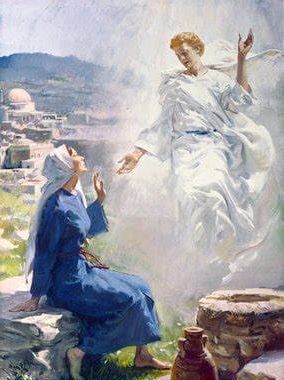
- But it is an expression of God’s trust in Mary, as what God is planning for her is both amazing and honoring, but also a heavy weight to bear.
- Societal shame, possibility of a broken engagement, an act (according to Moses) worthy of a death sentence (though that was no longer implemented often), the responsibility for a child in an insecure family situation and no commitment of a marriage, legal status of financial provision, relative poverty of the family and instable political times.
- To be a mother of an infant is a challenge (though also a joy), but to be the ‘mother of God’ is surely a whole different level of challenge.
- Upon hearing of a pregnancy, Mary asks “How can this be, since I am a virgin?” (Luk 1:34). Her question shows she is not naive or ignorant of how children are conceived. Her question is simple, straight forward and reasonable.
- When the angel explains the supernatural act that God will do in and though her, she humbly agrees to it “Here I am, the servant of the Lord; let it be with me according to your word” (Luke 1:38).
- She seems to understand that she has a voice in this, God is asking for her cooperation.
- She submits herself to God’s will, with all the joy, honor, awesomeness of it all, and all the price to be paid.
- May Mary’s simple and powerful prayer be our own: ‘Here I am, the servant of the Lord; let it be with me according to your word.’
- The angel also gives her a promise and prophecy about the child: It will be a son, whom she is to name Jesus, “he will be great, and will be called the Son of the Most High, and the Lord God will give to him the throne of his ancestor David. He will reign over the house of Jacob forever; and of his kingdom there will be no end” (Luke 1:32-33).
- Though Gabriel’s words show that the child will be “Son of the Most High”, Mary likely does not yet think as far as the second person of the Trinity stepping down into creation into her womb.
- She more likely understands it as most Jews would have understood it: He will be a godly person, with God’s favor and calling on him. He will come into leadership over the people of Israel.
- The reference to the “ancestor David” would be understood by Mary as a clear Messianic reference.
- The Jews expected the Messiah not to be ‘God come down’ but to be a second David, meaning a godly person who would be victorious in battle, rule and free the Jews and lead them to become again what they were meant to be.
- It is an amazing, head-spinning prophecy, even if the aspect of God himself coming down is not fully understood: She is to be the mother of the long-awaited Messiah.
- Gabriel informs her that her relative Elizabeth “her who was said to be barren” is pregnant in the 6th month.
Mary’s visit to Elizabeth – Luke 1:39-45
- Mary immediately sets out from Nazareth to Elizabeth’s town in the Judean hill country.
- This indicates that women, even unmarried women were able to travel, and act with some independence.
- This would not have been an easy journey as morning sickness is most common in the first trimester of pregnancy.
- It probably wasn’t easy for Joseph to trust and release Mary for this trip.
- Upon May arriving there, Elizabeth is “filled with the Holy Spirit and exclaimed with a loud cry, “Blessed are you among women, and blessed is the fruit of your womb. And why has this happened to me, that the mother of my Lord comes to me? For as soon as I heard the sound of your greeting, the child in my womb leaped for joy” (Luke 1:41-44).
- The miraculous nature of events is continued. Elizabeth here speaks by the Spirit and in a prophetic way. She has supernatural insight into the special role both children will play.
- There is also an interesting contrast at work: Elizabeth’s pregnancy is natural, though miraculous in the sense that it is a late pregnancy after decades of barrenness. Mary’s pregnancy is supernatural all the way.
- Elizabeth’s shame of childlessness is removed by her pregnancy, but Mary’s pregnancy brings societal shame on her, as it seems to indicate immoral behavior.
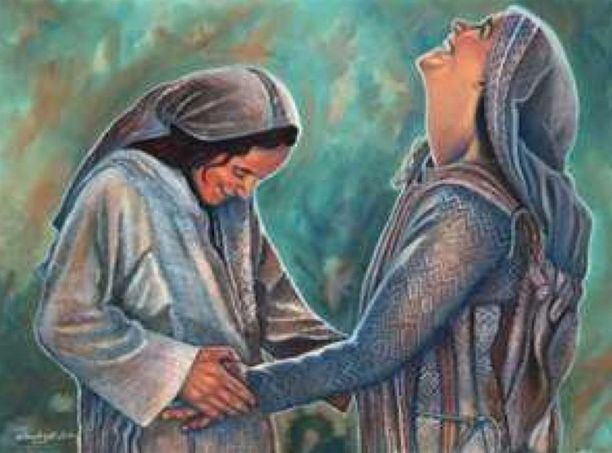
- Elizabeth’s words about Mary are prophetic: “And blessed is she who believed that there would be a fulfilment of what was spoken to her by the Lord” (Luke 1:45).
- The blessedness is not only in her being chosen for this important role, the blessedness is in her believing that God will do what he said and agreeing or obeying to this role.
- Also later with Jesus’ preaching we will see that he requires these two things: faith in and obedience to God’s word.
- May this same sentence apply to us, may we also be blessed because we believed what was spoken to us by the Lord!
Mary’s Magnificat – Luke 1:46-55
“My soul magnifies the Lord, and my spirit rejoices in God my Savior,
for he has regarded the low estate of his handmaiden.
For behold, henceforth all generations will call me blessed;
for he who is mighty has done great things for me, and holy is his name.
And his mercy is on those who fear him from generation to generation.
He has shown strength with his arm,
he has scattered the proud in the imagination of their hearts,
he has put down the mighty from their thrones,
and exalted those of low degree;
he has filled the hungry with good things,
and the rich he has sent empty away.
He has helped his servant Israel, in remembrance of his mercy,
as he spoke to our fathers, to Abraham and to his posterity for ever.”
- This beautiful prayer poem shows Mary exalting in the amazing role God has granted her to play.
- She rightly and prophetically says “henceforth all generations will call me blessed”, and so it has happened over the centuries.
- Many have called her blessed, and many have taken inspiration from Mary.
- The poem is a bit subversive also, she realizes that God is setting up a very different sort of kingdom: the upper class women were not the ones favored, but her, a simple girl.
- God scatters the proud, the mighty he puts down from their thrones, but hose who are of low degree are exalted, those hungry God has filled with good things while the rich have been sent away empty.
- Yet still, this new thing God is doing is in continuity with what God has spoken to Israel from Abraham onward.
- After about 3 months (Luke 1:56), so roughly when Elizabeth’s birth is near, Mary returns to Nazareth, herself 3 months pregnant.
Matthew’s account of the birth of Jesus – Mth 2:1-12
- Matthew gives a bigger picture for the birth of Jesus.
- Wise men from the East who have been observing the sky see something out of the ordinary, from which they conclude that a special king will be born to the Jews (Mth 2:2).
- They promptly undertake the long journey and seek for the newborn king where they suppose him to be: in Herod’s palace.
- Their arrival and quest upsets the power-hungry King Herod, who is infamous for even killing his own sons for attempting to capture the throne, as well as the people in Jerusalem, all seeking or fearing a Messiah-like figure for their own reasons.
- Herod shrewdly gathers as much information as he can from the wise men (timing of the appearance of the star) and from the priests, who tell him that the awaited one would be born in Bethlehem of Judah (Micah 5:2).
- Herod tells the wise men to find him and inform him also “that I too may come and worship him.”
- Actually, when the wise men are warned in a dream and don’t come back to him he proceeds to kill all male children under two, making sure the time indicated by the wise men is covered.
- The wise men re-discover the star and find the child, though this is likely a few months after the birth, offering it valuable gift of gold, frankincense and myrrh.
- This provision will help the family survived when fleeing and seeking asylum in Egypt.
Luke’s account of the birth of Jesus – Luke 2:1-20
- Luke adds another piece of historic context: “In those days a decree went out from Caesar Augustus that all the world should be enrolled. This was the first enrolment, when Quirinius was governor of Syria. And all went to be enrolled, each to his own city. And Joseph also went up from Galilee, from the city of Nazareth, to Judea, to the city of David, which is called Bethlehem, because he was of the house and lineage of David, to be enrolled with Mary, his betrothed, who was with child” (Luke 2:1-6).
- Censuses were conducted regularly by the Roman emperors and were perceived by subjugated peoples as not only inconveniences, but as tools of control and oppression, since tax collection was based on these censuses.
- Typically they were a time of civil unrest, and a disruption of life even for the peaceful, necessitating travel at a time when everybody is on the road.
- For a census to fall at such a date, requiring for Joseph to leave his normal surroundings and travel with a 9 month pregnant wife surely was very cumbersome, expensive and risky from a medical perspective.
- God surely doesn’t seem to cushion or pamper his chosen family.
- Bethlehem is packed with fellow-census-travellers and finding a place to stay is near-impossible.
- Actually Joseph would have had many relatives in Bethlehem, is he not welcome because of his wife’s stigma?
- Or are there so many traveling that even the relatives can’t host any more people?
- Joseph and Mary end up in some sort of a stable, just in time for Mary to give birth to Jesus.
- Conditions are far from ideal, and far from hygienic.
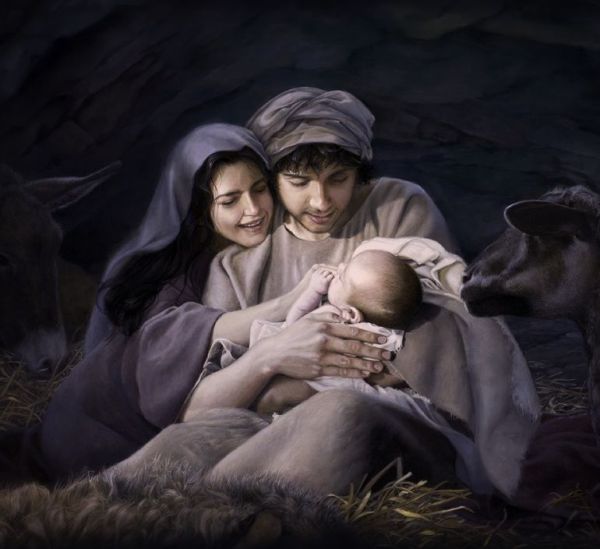
- Even though Jesus’ birth escapes just about everybody’s notice, God makes sure some shepherds get the message: “Be not afraid; for behold, I bring you good news of a great joy which will come to all the people; for to you is born this day in the city of David a Savior, who is Christ the Lord. And this will be a sign for you: you will find a babe wrapped in swaddling cloths and lying in a manger … Glory to God in the highest, and on earth peace among men with whom he is pleaded!” (Luke 2:10-12,14). Shepherds moved with flocks, and were known for burglaries and tall tales, not for faithful reporting. But God makes them messengers “they made known the saying which had been told them concerning this child; and all who heard it wondered at what the shepherds told them. But Mary kept all these things, pondering them in her heart” (Luke 2:17-19). How did Mary feel in a stable somewhere in an unknown city, giving birth with no mother or relative close by? How would it feel for the only people to celebrate with them being the local down-and-outs? We don’t know. Mary ponders and treasures the words of the shepherds, confirming what God spoke to her. The situation surely doesn’t feel like a king or ruler is born!
Joseph and Mary with the baby Jesus in the temple – Luke 2:21-39
- As good, God-fearing Jews Joseph and Mary circumcise Jesus on the eighth day, given him the name Jesus as the angel indicated and perform the purification rites in Jerusalem after a month to “present him to the Lord (as it is written in the law of the Lord, “Every male that opens the womb shall be called holy to the Lord”) and to offer a sacrifice according to what is said in the law of the Lord” (Luke 2:22-24).
- The fact that Joseph and Mary offer “a pair of turtledoves, or two young pigeons” (Luke 2:25) shows that Joseph and Mary are poor, for those of better standing a lamb was required as sacrifice (Lev 12:6-8).
- It seems that the visit of the wise men is after this event.
- When they visit the temple, two prophetic confirmations are spoken, both by old people who had waited for the appearance of the Messiah: Simeon (Luk 2: 25-35) and Anna (Luke 2:36-39).
“Now there was a man in Jerusalem whose name was Simeon; this man was righteous and devout, looking forward to the consolation of Israel, and the Holy Spirit rested on him. It had been revealed to him by the Holy Spirit that he would not see death before he had seen the Lord’s Messiah. Guided by the Spirit, Simeon came into the temple; and when the parents brought in the child Jesus, to do for him what was customary under the law, Simeon took him in his arms and praised God, saying, “Master, now you are dismissing your servant in peace, according to your word; for my eyes have seen your salvation, which you have prepared in the presence of all peoples, a light for revelation to the Gentiles and for glory to your people Israel.” And the child’s father and mother were amazed at what was being said about him. Then Simeon blessed them and said to his mother Mary, “This child is destined for the falling and the rising of many in Israel, and to be a sign that will be opposed so that the inner thoughts of many will be revealed—and a sword will pierce your own soul too.”
- Joseph and Mary are amazed, and strengthened by this supernatural confirmations of what they themselves heard from God.
- Jesus will be salvation, glory to the Jews and a light of revelation to the Gentiles.
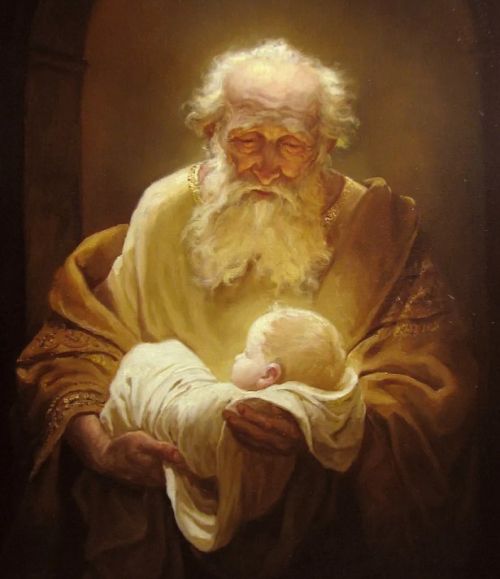
- Yet the Messiah is also “destined for the falling and the rising of many”, meaning people will have to respond to this Jesus, and their response will determine their outcome, their inner thoughts will be revealed.
- The very nature of Jesus’ calling, the cutting aspect of his message means that there will also be those who oppose, which will have an effect on his family.
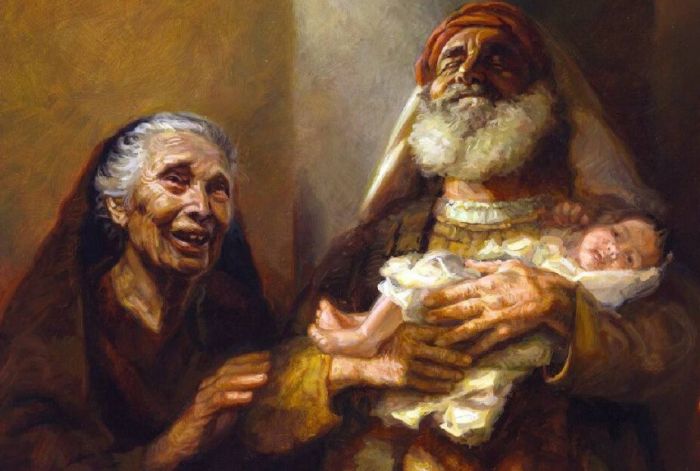
- Simeon also predicts that Mary’s soul will be pierced by a sword, possibly referring to her pain over seeing her son called “out of his mind”, judged a deceiver by the spiritual elite, plotted against, tortured and crucified.
- It also could refer to the moments when Jesus will not agree with her (Mrk 3:31-35), when she has to understand that she, too, has to respond to this Messiah.
- This message is further confirmed by Anna, daughter of Phanuel, who, upon seeing the child, starts to praise God and “speak about the child to all who were looking for the redemption of Jerusalem”.
Joseph and Mary flee to Egypt – Mth 2:13-18
- Joseph is warned by an angel in a dream to flee to Egypt, “for Herod is about to search for the child, to destroy him”.
- After the young family has finally reached a degree of normality, things take a dramatic turn, they become refuges in Egypt.
- Mary now finds herself a young refugee mother in a foreign country. The vulnerability of this young family is a continual reality.
- Yet Matthew is careful to point out that even these threats and renewed troubles are in fact fulfilling prophecy “Out of Egypt have I called my son”, quoting from Hosea 11:1. God is in control.
In this way they escape Herod’s massacre of children, but how would they have felt hearing about it later, especially as they ‘caused it’?
Joseph and Mary return from Egypt to Nazareth – Mth 2:19-23
- Again by instruction of an angel in a dream Joseph returns to Israel after the death of Herod.
- For fear of his son they do not return to Bethlehem, but to Nazareth, again fulfilling Scripture “He shall be called a Nazarene” (Mth 2:23, quoting Isaiah 11:1).
- Luke also mentions the family moving back to Nazareth (Luke 2:39).
Jesus’ childhood – Luke 2:41-52
- Luke summarizes Jesus childhood like this “And the child grew and became strong, filled with wisdom; and the favor of God was upon him” (Luke 2:52).
- Many readers would like to know more details about his childhood and family life, but we are not given this information.
- Only one story is specifically mentioned, the boy Jesus being left behind during one of the customary trips to Jerusalem (Luke 2:41-51).
- “When the feast was ended, as they were returning, the boy Jesus stayed behind in Jerusalem. His parents did not know it, but supposing him to be in the company they went a day’s journey, and they sought him among their kinsfolk and acquaintances.”
- These verses show that Joseph and Mary in general did not overly oversee, control or protect Jesus.
- This speaks of trust, and also of a humility. They seem to trust him to take care of himself and behave appropriately.
- They are raising this God-child, but they are not making it into a self-important role, rather they trust God with it.
- It also shows they as a family are connected to a wider social circle.
- When they realize they lost him, parental care and worry takes over and they search for him for 3 days, meaning he is missing 4 full days by the time they find him.
- On seeing him in the temple they are relieved and exasperated.
- Mary’s words have a clear accusing tone, we would agree with her: “Son, why have you treated us so? Behold, your father and I have been looking for you anxiously.”
- Jesus doesn’t say ‘sorry and thank you for caring for me’, he doesn’t accept their pressure, nor is he apologetic.
- Rather he challenges them: “How is it that you sought me? Did you not know that I must be in my Father’s house / about my Father’s business?”
- Jesus here exemplifies at age twelve own initiative, thinking and judgment.
- He expects his parents to understand.
- He has a strong sense of calling, purpose, security in and dependence on God.
- Yet “he went down with them and came to Nazareth, and was obedient to them”.
- Jesus, being 12 years old, still accepts their leadership, takes them as ‘authority from God’, but has own thinking already.
- Jesus – sinless – affirms and accepts God-given authority for his life at this point.
- “And his mother kept all these things in her heart.” Again we find Mary pondering, thinking and treasuring words spoken, trying to make sense of her role in being a mother to this growing son.
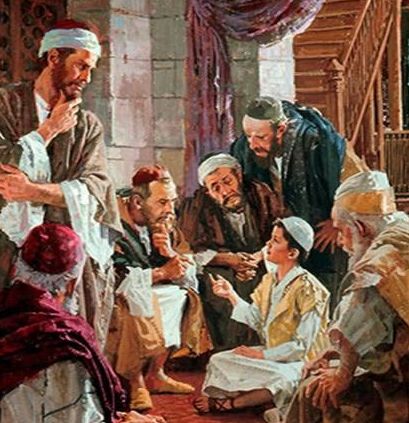
- This is also the last mention of Joseph. It seems he died relatively early, leaving behind a widow with at least 7 children.
- This also leaves Jesus as the firstborn with a challenge to early leadership, taking responsibility for the family and providing for them.
- Jesus would be the one to continue his father’s carpentry workshop and to keep training his younger 4 sons in carpentry.
Mary calling for a miracle – John 2:1-11
“There was a wedding in Cana … 3 when the wine gave out, the mother of Jesus said to him, they have no wine.” 4 And Jesus said to her “Woman, what concern is that to you and to me? My hour has not yet come.” 5 His mother said to the servants, “Do whatever he tells you.” … 7 Jesus said to them, “Fill the jars with water”
- Mary is concerned, maybe because it is a relative’s wedding, maybe because she knows how shame feels or maybe as a mother who is highly aware of others.
- Though John calls that ‘Jesus’ first sign’ (Jhn 2:10), she seems to have a positive expectancy of a miracle, and prepares practically by instructing the servants.
- Why? Did Jesus do miracles in the family setting before? If so, very limitedly, because he did not prevent Joseph’s death.
- Or has she perceived that he is ‘on the brink of launching out’? And is wondering how it will first come?
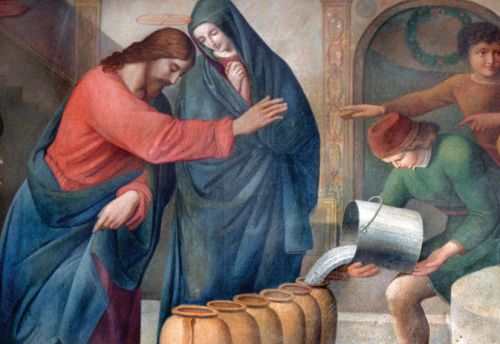
- Jesus’ answer “my hour has not yet come” seems to address this direction in her thoughts.
- Later Jesus will say the same to his brothers “my time has not yet come” (Jhn 7:6), though, when he is already in the middle of his ministry years, suggesting that this doesn’t refer to ‘first launching out’ but to obedience to the Father in general.
- Jesus’ answer is also an example of boundaries: “What concern is that to you or to me?”
- Jesus does not think every need is his to meet, every responsibility is his to take.
- Jesus being sinless this shows that also we can be godly, caring people and not take care of everything.
- We think: ‘he is able do something, therefore he should do something’. Jesus doesn’t sign up with this.
- What seems like only a few minutes later Jesus does exactly what Mary suggested: He does pick up the concern, he provides for the need miraculously, his hour seems to have come, suddenly.
- How did that just happen?
- Assuming that Jesus wasn’t just ‘annoyed at his manipulative mother’ and that he is sinless and caring at all moments this can only be understood in the following way:
- After Mary’s communication Jesus internally checks back with the Father: Should I address this? Is this the hour indeed? How should I do it?
- It seems the Father responds in the positive and Jesus goes ahead with his first miracle.
- It is important though, that Jesus here doesn’t respond with an ‘automatic accommodation’ to even a caring and unselfish request of his mother.
- Only when he feels God the Father telling him, he goes ahead.
- Need is no guidance. Ability is no guidance. Even caring and unselfish parental request is no guidance.
- Jesus is very clearly and carefully God-led and God-obedient.
- As an adult obedience to parents is no longer a ‘requirement of God’. A sinless Jesus refuses Mary’s request.
Jesus in fellowship with his family – Jhn 2:12
“After this he went down to Capernaum with his mother, his brothers, and his disciples and they remained there for a few days.”
- After the Cana wedding event Jesus travels to Capernaum with family and disciples.
- The reason for going is unclear, it could be a family related trip (as Cana probably was) or the family joining Jesus’ launching out in Capernaum.
- The time line is not easy to reconstruct as other gospels have Jesus first call disciples in Capernaum, here the disciples are already with him on the way to Capernaum, so possibly a later event but his family still supporting him?
Mth 10:35-37, Luk 14:26 – Jesus brings disunity to families
“35 For I have come to set a man against his father, and a daughter against her mother, and a daughter-in-law against her mother-in-law; 36 and one’s foes will be members of one’s own household. 37 Whoever loves father or mother more than me is not worthy of me; and whoever loves son or daughter more than me is not worthy of me.”
“26 Whoever comes to me and does not hate father and mother, wife and children, brothers and sisters, yes, and even life itself, cannot be my disciple.”
- Both Matthew and Luke have this verse in connection with uncompromising obedience to the call of God.
- Matthew uses the hyperbole: “I have come to set a man against”… actually God doesn’t cause the hostility, but it is caused by family not understanding but rather opposing the calling of a family member.
- Luke uses this hyperbole: “whoever … does not hate”. Actually God doesn’t command to hate, but he is clear that He has to have priority over parents if the two stand in opposition. Or priority over children if the two stand in opposition.
- Mth 10:37 spells out the same thing not as a litote, but as a straight sentence: You must love, obey and give priority to God over family members, however dear and close.
- Godly family members should support and encourage a person’s pursuit of God and obedience to calling, even at cost to themselves (distance, risk, financial loss, less financial security).
- If they do not, the person has to choose to disappoint family rather than disobey God.
- How would Mary feel when hearing Jesus teach these things or when hearing others reporting it to her? Is that part of the sword that will pierce her soul?
- That a part of Jesus’ fame and also the controversy around him falls on his family is also visible in “Is not this the carpenter’s son? Is not his mother called Mary? And are not his brothers James and Joseph and Simon and Judas?” (Mth 13:55, Mrk 6:3).
- People link Jesus back to his family, whether they want it or not they are also in the limelight – especially Mary.
- Was she proud of him? Probably in the beginning.
- But as things progressed and the opposition of the spiritual leaders against Jesus grows, Mary probably was more than anything worried.
Mrk 3:19-22 – Jesus’ family trying to restrain him
“Then he went home; 20 and the crowd came together again, so that they could not even eat. 21 When his family heard it, they went out to restrain him, for people were saying, “He has gone out of his mind”. 22 And the scribes who came down from Jerusalem said, “He has Beelzebul, and by the ruler of the demons he casts our demons.”
- As Jesus ministry progresses, his acts draw both increasingly large, fascinated but also demanding crowds, pressing in on him (Mrk 3:10), barely letting him eat (Mrk 3:20), and ready to make him king (Jhn 6:15).
- On the other hand, having become a name and a popular movement, Jesus is under increasing scrutiny by the spiritual leadership in Jerusalem.
- Some also think Jesus is “out of his mind” and report so to his family.
- These could well be relatives, friends or Capernaum neighbors.
- This also seems to indicate that none of Jesus’ immediate family are following him at this time.
- His family (which would mean primarily Mary), upon hearing the reports, is worried enough to feel obliged to act: they go out to restrain Jesus.
- They seem to be mostly motivated by care for Jesus, though there also seems to be a worry about the implications Jesus’ life might have on them and their reputation.
- Their attempt to restrain Jesus would most likely be an urgent verbal request including an emotional appeal, especially by Mary, or possibly by the brothers on behalf of Mary.
- Again there is no evidence of Jesus heeding this urgent request at all.
- He keeps obeying God even over concern, disagreement or opposition by his beloved family.
- How would Mary have felt? Was it hard for her to see her godly son deny her request? Did she realize that her expectations of what the Messiah would look like needed adjustment? Was she disappointed? Worried? Alarmed? Fearful? Annoyed? But Jesus is even clearer:
Mrk 3:31-35 (Mth 12:46-49) Jesus refusing his mother’s demand
“Then his mother and his brothers came; and standing outside, they went to him and called him. 32 A crowd was sitting around him, and they said to him, “Your mother and your brothers and sisters are outside, asking for you.” 33 And he replied, “Who are my mother and my brothers?” 34 And looking at those who sat around him, he said, “Here are my mother and my brothers! 35 Whoever does the will of God is my brother and sister and mother.”
- Mark and Matthew’s account put this event into the context of Jesus being judged by the scribes & Pharisees from Jerusalem and labelled as ‘demon possessed’.
- This – according to Jewish traditions (Fruchtenbaum) – is already a second stage: when confronted with a possible heretic the priests will first send out a fact finding delegation that asks questions and reports back.
- Based on that a second delegation is sent to address the heretic (here).
- Jesus by now is getting opposition not to be ignored, probably another reason why his family feels they need to intervene this time.
- This is the first time Jesus’ sisters also are mentioned, the entire family has come out to speak with him.
- Why the sisters? Maybe because as women they are most affected by their elder brother’s difficult reputation?

- Note that the family’s behavior is not exactly polite nor respectful: They do not go in, they do not sit down, they do not listen to his teaching, they do not wait for him to finish. Rather they send someone in to call Jesus out.
- Basically they demand access – and immediate access – on the grounds that they are his own family: Jesus should stop teaching, leave all the followers waiting and come out to attend to them … why? Because they are blood relatives.
- The incidence is highly public, in everybody’s eye, and they don’t mind. By their behavior they (maybe unconsciously) try to impose a hierarchy on the people present.
- Jesus refuses in an act that seems quite rude.
- The incidence is highly public – not by Jesus’ choice – and so he responds publicly: He will not meet their demand, he will not stop teaching, he will not prefer them over the other normal people on the grounds of family relations, he refuses their approach, hierarchy and the message that sends to others.
- “Whoever does the will of God is my mother, brothers sisters” With this Jesus is levelling the ground.
- He is valuing the willing heart-response of the normal person over the claims of relations and position.
- There is only one way to God, and that is though a heart-response to grace offered: faith and obedience.
- His family is welcome, but if they come, this is how they will have to come.
- Jesus’ family and especially Mary would definitely have been offended at this behavior, and most Jews would have taken her side.
- Mary and the brothers may have stomped off in anger or offense.
- Or maybe they recovered, waited for him to finish things and met him later.
- Though probably quite offended in the moment, Mary and Jesus’ family in the long run understands and accepts Jesus’ message to them: They are welcome, but not on grounds of special claims. Later when they become Jesus’ followers (Acts 1:14), they become followers like everybody else and no longer claim special access or favors any longer.
- So is has to be concluded that Mary is definitely saved, but not because she gave birth to Jesus, rather because she became a follower of Jesus.
- She eventually responds with humility, faith and obedience, – as all his other followers do.
- It is clear from this passages, that an and adult Jesus here disobeys his family’s urgent request, and more specifically his mother’s stated will.
- This shows two categories of limits to obedience of a child: Obedience as such is not required of an adult child.
- Obedience is not required if it is in opposition to God’s will.
Jhn 19:25-27 Jesus covering for family responsibilities
“Meanwhile, standing near the cross of Jesus were his mother, and his mother’s sister, Mary the wife of Clopas, and Mary Magdalene. 26 When Jesus saw his mother and the disciple whom he loved standing beside her, he said to his mother, “Woman, here is our son.” 27 Then he said to the disciple, “Here is your mother.” And from that hour the disciple took her into his own home.”
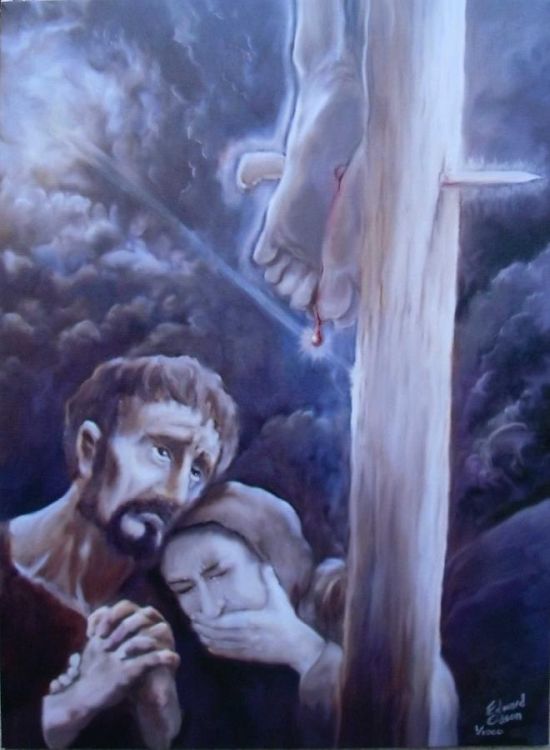
- Mary is present at the cross, whether because she is a follower by now, or whether worry and care drove her here.
- Witnessing the cross she is surely in utter shock, pain and turmoil.
- Shock at what is happening, pain at seeing her son suffer and being forcefully taken from her and turmoil as everything she believed – God’s promises of Jesus being the Messiah, the deliverer, the ruler of Israel – seem to evaporate before her very eyes.
- Did God lie? Did she trust a deception? Was Jesus who he and the angel had said he was? Then why was this happening?
- Mary must have felt like all rugs being pulled out from underneath her, of the sky falling apart and reality she knew collapsing.
- Jesus – as a godly son – is trying ensuring that his mother is taken care of after his death.
- As far as he can he tries to cover for his responsibilities, though his early death and departure is part of his calling that he can’t and won’t prevent.
- Jesus has four younger brothers, why does he feel he needs to give responsibility for his mother to his disciple John?
- Maybe because the brothers are not yet his followers at this time, though before long they will be.
- Fellow believers become family (Mrk 10:30, Luk 18:30) and can be asked to take care of family responsibilities.
- This models that ‘taking care of each other’. Jesus has no hesitation here to ask for a service, a commitment.
- Within the boundaries of God’s calling and God’s principles one needs to do one’s best to fulfil responsibilities to family: “And whoever does not provide for relatives, and especially for family members, has denied the faith and is worse than an unbeliever” (1 Tim 5:8).
Mary as a believer in the early church – Acts 1:14
“All these were devoting themselves to prayer, together with certain women, including Mary the mother of Jesus, as well as his brothers.”
- After Jesus’ death and resurrection Mary and others in Jesus’ family become his followers – and on the same terms as everybody else: faith and obedience, not on being a blood relatives.
- Presumably Jesus’ physical mother and brothers were treated with honor in the first church, but immediate special status or other grounds for higher position are not visible in the New Testament writings.
- Jesus’ brother James (the oldest of the four mentioned in Mth 13:55, Mrk 6:3) becomes over time (after Peter) a revered and influential leader of the Jerusalem church. His adherence to the Jewish law makes him first an influence in favor of circumcision (Gal 2:12, Act 15:1).
- When the issue is properly addressed in the Jerusalem council (Act 15) it is James who after much discussion comes out with the concluding verdict of not requiring Gentile believers to keep the Jewish law: “Therefore I have reached the decision that we should …” (Act 15:19).
- Why him? Possibly because of his prominence in the Jerusalem church, but even more so because he seems to have been the main figure of the pro-circumcision position, so his change of mind signals to all the now apparent rightness of what Paul and Barnabas have stood for (Gal 2:11-14, Act 15:1-2).
- James, brother of Jesus, is the writer of the epistle ‘James’ a He identifies himself as “James, a servant of God and of the Lord Jesus Christ” (Jam 1:1) and doesn’t come out with his being Jesus’ own brother.
- The descriptions remaining in other Jewish writings describe James as living a life of exceptional devotion and prayer and that he was revered even by Jews that opposed the church. Josephus Flavius describes his martyr’s death at the hands of the Jews.
- The last brother of Jesus mentioned in Mth 13:55 and Mrk 6:3 is Judas (or Judah or Jude), the writer of the epistle ‘Jude’, who humbly identifies himself as “brother of James”, not ‘brother of Jesus’ (Jude 1). Both brothers have truly learned their lesson.
- According to church tradition (Ireanaeus), Mary is taken by John to Ephesus before the fall and destruction of Jerusalem in 70 AD.
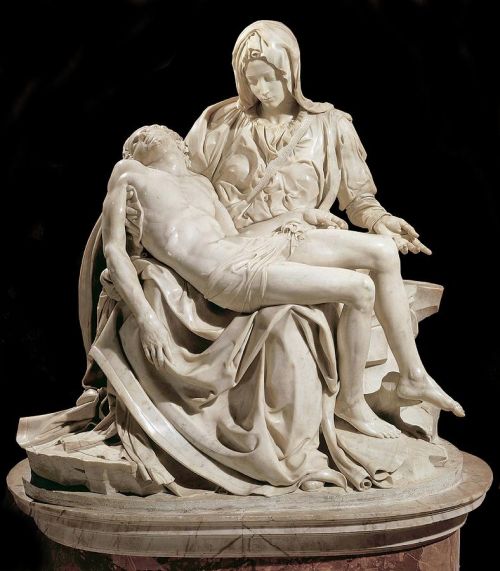
La Pieta by Michelangelo
- The world famous depiction of Mary, holding her dead son Jesus in her lap by artist Michelangelo is indeed of extraordinary beauty.
- It is also heavy with meaning: Mary has committing the most precious thing she has to God.
- She gives her Son to the world for the world to be saved.
- This picture of a human mother making the right sacrifice, not claiming her son or holding him back but letting him be what he needs to be, is indeed inspiring.
Summary
- Mary is one of the outstanding figures of the New Testament.
- She agrees to the both honorable and difficult role God wants her to play.
- She accepts both the joy and the pain and even though she cannot possibly foresee how much joy and how much pain it will mean, she takes events as they come.
- Though there are times when she doesn’t understand Jesus, or even feels the need to nudge, correct or even restrain him and even though she was likely offended at Jesus’ occasional refusal of her request or demand, she does come through it all.
- She finds again to the humility to agree to God’s way, even if it means to not have special access to him as his mother, even if it means she needs to humble herself and become a follower of Jesus like everybody else.
- Though all this was surely more than challenging, she comes through victoriously.
- She becomes a believer and a follower of the Messiah by faith and obedience, like all believers do, though he happens to be her son.
- She is indeed honored, as she herself foresees in her Magnificat “surely, from now on all generations will call me blessed; for the Mighty One has done great things for me” (Luke 1:48).
- And she is indeed blessed as Elizabeth said: “And blessed is she who believed that there would be a fulfilment of what was spoken to her by the Lord” (Luke 1:45).
- May we learn from Mary’s example and also be blessed as we believe that there will be a fulfilment of what was spoken to us by the Lord!