Introduction
  • The most foundational thing that can be said about the God of the Bible is that he is a Trinity, three persons, yet one God.
  • The very fact that the God of all reality is a Trinity, how does this bear on the different domains?
  • How is it the basis for each domain?
  • How is it the basis for the relationship between the domains?

The triune God (his nature & character) is the basis of …

  • shared power, shared authority
  • group leadership, commonly held office
  • model of leadership by service, obedience, self-control, consulting, consensus
  • self-government as condition to governing
  • consensus government, common decision, process of suggestion, evaluation, contribution, agreement (Gen 1:26)
  • lawfulness, legitimacy
  • the affirmation of diversity, multiplication, increase of population > need for organization

The triune God (his nature & character) is the basis of …

  • generosity, giving, serving, providing for
  • selflessness, preferring one another, serving one another

The triune God (his nature & character) is the basis of …

  • basis of lawfulness, not randomness, not arbitrariness, consistency
  • affirmation of reality
  • Reflected in great grand diversity of species (Example: 7000 types of seashells on a beach in the Philippines)
  • Reflected in the multiple multiple functionalities, looks, textures, colors, abilities, appearances, tastes, sounds, …
  • affirmation of diversity, multiplication, increase of population > need for organization, intervention, innovation, science, technology

The triune God (his nature & character) is the basis of …

  • relationship: reality of, need for, affirmation of, celebration of, cruciality of
  • community
  • a circle of love
  • love as condition to authority
  • model of leadership by service, preferring & acknowledging each other
  • diversity, complementing, contribution
  • the affirmation of multiplication, growth, new life, differentiation, diversification, spreading out, new units

The triune God (his nature & character) is the basis of …

  • basis for communication, need to tell, to inform each other
  • basis for wisdom, consultation, sharing of thought
  • Affirmation of diversity, multiplication, need for hand over, pass down, spread, development of knowledge and skill.

The triune God (his nature & character) is the basis of …

  • communication: the ability, commitment to and joy in communicating
  • basis of sovereignty
  • basis of objective reality, describable realities outside my mind
  • basis of truth, something is true, something true can be said

The triune God (his nature & character) is the basis of …

  • Love, selflessness and service to the other as the basis and standard of everything
  • priestly function of mediating, standing in the gap, interceding

The triune God (his nature & character) is the basis of …

  • diversity, reality, affirmation, celebration of diversity
  • unity, something common, community, something to celebrate
  • affirmation of identity, individuality, contribution, complementing
  • affirmation of individuality, celebration, of senses, of real world
Summary

The triune God (his nature & character) shows
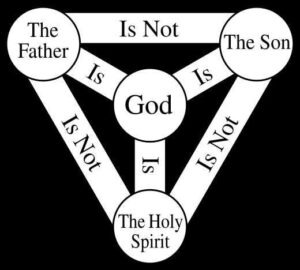
  • the need for all domains
  • the need for interaction of the domains
  • the need for mutual complementing of each other of the domains
  • the need for each domain to know its role, to ‘stay in its track’, to not usurp ground
  • that authority is given where authority needs to go, right interplay of appropriate authorities and contributions
  • commitment to mutuality, complementing each other, diversity, unity







